Background: Today I'm taking over for the usual man behind the Depths to talk about a film that's close to my heart (these reviews aren't supposed to be completely unbiased, are they?). I saw Silver Streak on TV a few years ago and got completely wrapped up in it, and ended up buying the DVD. It only has 53 reviews on Netflix, which is surprising considering the fact that it's the first film that featured the golden team of Gene Wilder and Richard Pryor together. They went on to make several more movies together and have come to be considered one of the great comedy teams o the era. Oh, and the movie was directed by Arther Hiller, who also did Love Story, in case that means something to you (you know, "Love means never having to say you're sorry").
Plot: All over the place. This might turn some people off, particularly one or two Netflix reviewers who were pulling their hair out over the genre dilemma ("Is it a comedy? A murder mystery? A road movie? A buddy movie? A romantic comedy? WHAT!?") but I personally thought it was entertaining. The basic plot line is that Gene Wilder is on a train for a business trip and in the middle of seducing--or being seduced by--Jill Claybourgh when he sees a murdered man fall off the train outside his window. This leads him on a jaunty quest to solve the murder mystery, which involves him falling/being pushed off the train multiple times, striving to get back on it to save Claybourgh, and finally meeting up with Pryor for some comedic gold. Spoiler: there's a happy ending for everyone but the bad guys. Even the train is smiling at the end.
Why was it forgotten? It's a fun romp but even with Wilder and Pryor, I imagine it's hard for this film to be taken very seriously. It's basically a poor man's North by Northwest. Also, I can't say the suspense that's promised on the pictured DVD cover is really all that thrilling. Take it from someone who jumps while watching Halloween specials on the Disney channel (what? I have siblings): the murder mystery part of this movie is not very scary. Then again, it doesn't really need to be.
What went right? It doesn't take itself too seriously, and personally I'm a huge fan of pretty much anything Wilder does. Also, while some might complain about the film's inability to stick to one genre, I think the mashup is what makes it so much fun. It's definitely more of a comedy than anything else, but it has just the right amount of romance and shoot outs.
Verdict: Easy fun, worth watching just for Wilder and Pryor.
Score: 85%

A blog where I search out forgotten hidden gems in the enormous pile of Netflix Watch Instantly titles.
Friday, November 18, 2011

Monday, November 14, 2011
Flakes (2007)
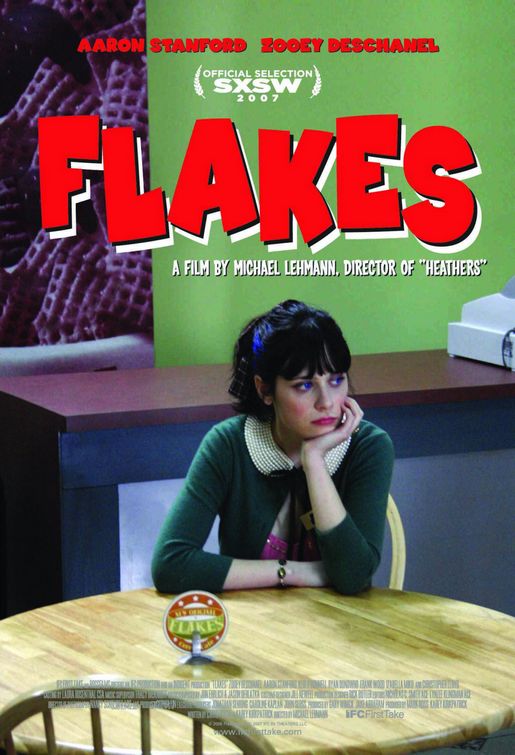
Background: I don't think lead actress Zooey Deschanel really needs much introduction. She's the sister from Almost Famous, Summer from 500 Days of Summer and you cannot legally mention her or any of her roles without using the word "Quirky." Her big blue eyes and singing voice that outclasses her acting by a damn mile have made her a staple of the dreams of hipster men nationwide. She also has a show on Fox called The New Girl that I know absolutely nothing about. Her sister, Emily Deschanel, has a show on Fox too, Bones, about which I know very little more. I don't mean to sound dismissive because I really actually like Zooey Deschanel and have watched movies specifically because she's in them, though I'll never forgive her for Yes Man.
Slightly less well known is Michael Lehmann, director of today's film. He's had quite an odd career. He's spent a lot of time directing TV shows. Though this usually means that the best one can hope for from the direction is "workmanlike," he's spent most of his time on more cinematic shows, usually on premium cable. His movie work is also pretty interesting. His first feature length credit is Heathers, a favorite among some. His cult hits don't stop there, he also made Airheads, a personal favorite of mine. Then again, he also directed Hudson Hawk…
Plot: As the manager of a restaurant that serves only cereal, Neil Downs feels slightly unsatisfied. He's a budding musician with writer's block, a cereal enthusiast and boyfriend to Zooey Deschanel, whose quirky character (sorry, just fulfilling my duty) changed her name to Miss Pussy Katz on her 18th birthday. The restaurant is called "Flakes," naturally and it's owned by Willie, a constantly pajama clad Christopher Lloyd. Other characters haunting the cereal bar include an amateur cereal historian and a man that just loves hats. He's apparently bad with their names though because he refers to a Deerstalker hat as a Deerslayer hat. This is never acknowledged. One day a business man comes in to Flakes and starts asking questions about franchising.
Turns out the businessman was just pumping them for information. His plan was to open up a new cereal joint right across the street called "New Original Flakes." This, of course, tanks at first. It's too clean, there's no atmosphere, etc. Everyone loves the old Flakes, why would they go to the cheap knockoff. Well, after a fight, Zooey goes to work there and gives it the atmosphere people crave. It's not clear why all the old regulars jump ship and go across the street to their beloved hangout's rival, but that happens.
This causes Flakes business to go down the tubes. Zooey figures this should give Neil more time to work on his album, but writers block is fickle (trust me) and all it does is make him frustrated. The plot has exactly zero moments that you don't see coming from the first moment the business man enters Flakes for the first time. That's not always a bad thing, but in this case, it certainly doesn't help.
Why Was It Forgotten? It's very hard for an indie movie to break through to the mainstream. Especially when the movie is as obtusely quirky as this one. When you think of movies of this ilk that the general population have embraced, like say Little Miss Sunshine or Juno, it can be hard to tell why those two are popular while no one cared about this one. It has well known names like Little Miss Sunshine, Zooey Deschanel and Christopher Lloyd in place of Steve Carell, Alan Arkin and the like. It has highly quirky characters like Juno, cereal and hat enthusiast stand in for the fast talking teens.
While those movies certainly have their fair share of problems, what they had was likable characters. Well, to a point at least. I thought Juno was a really terrible character and everyone in Little Miss Sunshine was just kinda boring, but they didn't hold the terrible opinions and make the awful decisions of the characters here. Especially those of the main character Neil. A main character that is impossible to like makes the movie hard to bear.
What Went Right? Christopher Lloyd is always a treat. He may be older and much more haggard these days, but when he gets worked up, it's just like the old days with Doc Brown in Back To The Future. Zooey Deschanel is also adorable as always, though her character doesn't really have personality. She does have moments though where she's funny. Makes me think I should check out that show, but chancres are I never will and I know that.
Verdict: Well, at least it's not Juno.
Score: 38%
Thursday, November 10, 2011
Tekwar (1994)

Background: Imagine yourself as William Shatner on the set of Star Trek V: The Final Frontier. You're getting way too old to play the dashing ladies man Captain James Tiberius Kirk, but you need a paycheck so you're doing it anyway. By this time, Star Trek: The Next Generation has been on TV for years. You've been replaced Captain of the USS Enterprise for an entire generation of young nerds. You've been going to conventions for decades, being hounded for autographs by millions of people who want nothing more than to correct you about some piece of Star Trek lore that you misspoke about at last year's convention. You probably want to break free from that whole world right? Maybe create your own sci-fi future nonsense? Well, in 1989, Shat did that.
In 1989, Shatner decided it was time to break out the… whatever existed before computers. Abacus? Anyway, he wrote a book called Tekwar. Then he wrote another book, TekLords. He's pumped out nine of these bad boys in total, all with "Tek" in the title somewhere. These books have been made into movies, a TV show, a series of comic books, and a pretty crummy looking video game. If you ask around the right circles, Tekwar is famous, but around the Netflix circle, it's lost. Why no love for the Shat?
Plot: There is a whole ton of plot here, as is often the problem when a book is made into a movie. There are right ways and wrong ways to do adapt a novel. You can choose to tell a stripped down story in detail, or you can briefly cover everything that happened in the book. This bets big on the latter. First thing's first. Tek is a new drug out on the streets. It's the microchip thing that when plugged into this little headset, lets you see in virtual reality. I'm not sure what makes one have to buy more of it though. Seems like a microchip is more than a one use thing.
Jake Cardigan is a cop who got thrown in cryo-prison. Sorta like John Spartan in the much better movie Demolition Man. He, of course, was framed. It's never really explained too well what happened, but there was a Tek deal, people think he paid off the bad guys, other cops got killed. Bad stuff, you know. He's looking for his wife and son, she left him while he was frozen. He goes to some hackers who are super annoying to try and find them. The computers are really secure though and they have to fly through hologram cyberspace to get through. I guess this is supposed to be tense, but it makes so little sense that it's hard to feel anything except confusion.
Speaking of confusion, the rest of the movie is some of the most confusing stuff I've ever watched. I'm sure that if one really tried, it wouldn't be too hard to follow, but there's just way too much plot for 90 minutes. There are TekLords like Sonny Hokori who control all the Tek. There's Shatner who runs a corporation that has a way to destroy the world's supply of Tek. Hokori's brand of Tek would be immune though. This seems like it should be the crux of the movie, but very little thought is given to it. There's also the eco-terrorist/Jakes ex-girlfriend Warbride. I can't make head or tails out of her involvement. There's a robot hitting snapshots at Jake in a hockey arena. I dunno, maybe the book makes more sense.
Why Was It Forgotten? The key to great sci-fi is telling a good story that works when you take all the spaceships and cyberpunk out. Take Star Trek for example. What made it stand out certainly wasn't the great acting and superior special effects. People loved that show because of the way the characters interacted and worked out the myriad of problems they were faced with every week. The recent reboot of Battlestar Galactica was so well respected because it would work if it were on Earth and there were no robots. This wouldn't work like that at all. Take away all the future mumbo jumbo and you have a really really boring, uncreative story. The only parts that are even a little interesting are just incredibly confusing.
The other fun part of Sci-Fi are the predictions it makes about the future. It's always neat to go back even just 15-20 years when this came out to see what they thought the near future was gonna be like. This movie gets shockingly few of them right. Sure, this movie takes place another 30 odd years from where we are today, but still. For just one example, money is transferred between people by linking up these personal devices about the size of a deck of cards. The way things are going with Near Field Communication and Bluetooth, there's no way anything will ever come in contact with anything ever again.
What Went Right? No part of this movie is particularly bad. Sure parts of it are dated and none of the future drug nonsense makes a whole lot of sense, but if you want to lose yourself in a world, there is a ton of information to lose yourself in. I think that's why there's still a small, but very loyal following around Tekwar. Outside the novels of Neil Stephenson, there's really not a whole lot of quality cyberpunk. Actually, you know what? There might be, I really have no idea. None of it has the name "William Shatner" on it though.
Verdict: There's a whole bunch of Tekwar movies on Netflix. I don't think I'll watch more of them
Score: 25%
Monday, November 7, 2011
The Wilby Conspiracy (1975)
Background: Sydney Poitier and Michael Caine ain't gonna play Sun City. It's safe to say that in 1975 Aparthied wasn't very popular around the globe. Enter The Wilby Conspiracy, a novel by Peter Driscoll turned into a film by acclaimed director Ralph Nelson. Nelson had previously directed the adaptation of Flowers For Algernon, Charly, which I watched in 8th grade English class and remember almost nothing about as a film. Most people would know him best for directing Lilies Of The Field, for which Sydney Poitier won the Best Leading Man Academy Award, the first African American man to do so. With two well known leading men, an equally well known director, and even a young Rutger Hauer in there being Rutger Hauer, it's hard to imagine this film getting lost to the ages, right?
 Plot: Poitier starts out the film as a mere number, 34. A political prisoner in apartheid era South Africa, full name Shack Twala, incarcerated for a decade already, he stands trial to possibly spend even more time in prison due to a new law that prosecutes terrorists. He gets off the hook thanks to a pretty young lawyer named Rina Van Niekerk (These South African names are murder). To celebrate, she offers to take Twala and her boyfriend, James Keogh (Michael Caine) back to her office for champagne.
On the way there, shit gets real, they get stopped by the cops who say Twala can't be on the street. Because of racism. The cops cuff him and commence whaling on him because of racism. Twala and Keogh don't think this should happen, because they're the good guys and begin whaling on the cops back. They put the cops in the hospital, have to run away for obvious reasons, and the movie is underway.
They decide they need to make their way across the border to Botswana for safe haven. Along the way, it comes out that Twala is a member of the Black Congress, a group that helps blacks fight for freedom against the imperialist whites. At the head of this organization is the eponymous Wilby Xaba. The South African Bureau of State Security wants to capture Wilby, and now they have some unwitting patsies that will lead Major Horn, leader of the bureau, straight to him.
Along the way, the movie gets lost in some side plots with diamonds and Indian dentists that I won't give too much away about. Racism and getting lost in plot twists are the two leading themes of this movie.
Why Was It Forgotten? Apartheid was a total bummer, and that might have something to do with it. The main thing about apartheid is that it doesn't exist anymore, thus dating a few early episodes of The Simpsons where Lisa has an "End Apartheid Now" poster on the door to her room, also abolishing violent, deplorable segregation in South Africa. A movie that graphically shows the consequences of apartheid doesn't really play in this day and age. Also the movie only saw a limited release in North America and Netflix only services the U.S. and Canada. It has been released on region 1 DVD though, and the more global IMDb shows an almost equal amount of apathy.
What Went Right? Poitier and Caine show a playful, Lethal Weapon, anti-buddy relationship that is really fun to watch through the entire movie. The dialogue is consistently snappy, as in this quote from Caine: "A politically commited Indian dentist? That sounds like all the people I can't stand at a cocktail party!" It's unfortunate that Poitier is shackled (bad word choice, I guess) with a tricky native African accent that reigns in his performance hard. There are also a few genuinely exciting set pieces, one with a giant sinkhole, another with a bunch of planes, that keep the action going.
Verdict: It might get a little lost, but overall a pretty enjoyable watch.
Score: 80%
Friday, November 4, 2011
The Killing Of A Chinese Cookie (2008)

Background: First off, I should say that this is not a typo, and I am not actually reviewing the Cassavetes film The Killing Of A Chinese Bookie. Though that would be great and all, it goes against the idiom of The Depths. This, however, is a documentary about fortune cookies. I love fortune cookies, and I love obscure puns, so this movie has a hook in me from the start. Documentaries about unusual subjects have always fascinated me. Men Who Swim is a perfect example. The fortune cookie is about as unusual as a topic can get. At a mere 75 minutes, it seems like it might have been a little bit too unusual a subject, perhaps.
This is the first feature length documentary from director Derek Shimoda. He's previously worked in the film industry on small, independent movies. He's been featured in a number of film festivals though, including Sundance. The website for the movie is littered with wreaths of various film festivals, though distressingly, only one pull-quote from a critic. Even more distressingly, the critic is from Variety.
Plot: As expected, this is a movie about fortune cookies. First thing, however, the lottery. It starts with a story about a Powerball drawing with over 100 winners. Every one of them chose the same numbers for the same drawing. The implication is that they used fortune cookies and the lucky numbers that appear at the bottom. This revelation, however, is left for the final scene. After that, it dives straight into the history and invention of the fortune cookie. Turns out, who actually made the first fortune cookie is hotly contested. There are three candidate. First is David (or Davis) Jung from L.A. He owned the Hong Kong Noodle Company, a longtime manufacturer of the cookies. Next was Japanese immigrant Seiichi Kito. This theory is put forth by Ripley's Believe It Or Not, but not too many people put a lot of stock into it. The third possible inventor is Hakoto Hagiwara, another Japanese immigrant who moved to San Francisco. This all takes place in the early 1900s.
The provenance of the fortune cookie is so hotly contested, that in the '70s, they held a mock trial called "The Court Of Historical Review" to decide once and for all. The trial takes place in San Francisco and Hakoto Hagiwara, the one who lived in SF wins. The advocate for David Jung from L.A. still seems surprising angry about the whole situation. You may notice that I said Hagiwara was Japanese and not Chinese like we associate with the cookie these days. Turns out the fortune cookie is based on a Japanese cooke called senbei. It has a similar shape and ingredients, though is slightly different and has no fortune inside. The Japanese immigrants of the time sold the cookies to the Chinese restaurants that were becoming more and more popular with the locals and thus it became known as a Chinese thing.
The movie then goes on to describe the differences between how the cookies were made when they were first invented and how they're made today. They used to be made one at a time by hand, now they have machines that pump out millions of the things every day. Most interesting is the talks with the people who actually write the fortunes. Though you may expect them to be taken from ancient chinese texts, one writer they tracked down isn't even Chinese or spiritual. There's also a whole lot of garbage and stories that are really only tangential to the cookie, but those really aren't important. Thankfully, the section about adding "In Bed" to the ends of fortunes is kept mercifully short.
I don't need to tell you that the movie also features scenes of the various interviewees cracking open the cookies and reading the fortunes.
Why Was It Forgotten? There is certainly a good documentary to be made about the history, manufacturing and current state of the fortune cookie, but this is definitively not it. To start, the section about the history of the fortune cookie has a serious problem with setups. It featured many interviews with descendants of the supposed inventors of the fortune cookie. However, none of those supposed inventors are introduced first. So the great grandson of Hakoto Hagiwara would talk about his family's history with the fortune cookie, but without the background of who Hakoto Hagiwara is, it's both hard to follow and hard to care about.
Another major problem is that it takes a lot of time, even during the short run time of the movie, telling stories that are only vaguely related to fortune cookies. The movie spends equal time on the history of the Japanese senbei cookies as it does with the background of the fortune cookie. Far less interesting is an extended section about an art show where the artists make pieces based on fortunes.
What Went Right? Some of the interviews are actually really interesting. As previously mentioned, the section with the people who write the fortunes was really neat. Also, some of the more famous interviewees provide much deeper insight than others. These include Martin Yan of the old cooking show Yan Can Cook and Philip Chiang, founder of the P.F. Chang's chain of restaurants. There's a lot of interesting ideas in this movie, but they are really poorly executed.
Verdict: I once got a fortune that said "You like chinese food"… In bed! Ha!
Score: 25%
Monday, October 31, 2011
Who Saw Her Die? (1972)
Background: This is a giallo movie. "What's giallo" you ask? Broadly, it's less a genre than a style of movie. After the spaghetti western crazy of the 60s, Italian filmmakers turned their fancies to other genre pictures. Giallo literally translates to "yellow," referring to the covers of pulp novels in Italy at the time. Giallo movies are noted for the pulp novel tendencies. They use atmosphere to set their moods, lighting and colors are very important. Typically giallo movies are thrillers, but also with modern slasher-movie tendencies. Dario Argento and Lucio Fulci are famous for their giallo work.
This movie specifically though has some interest about it too. It stars George Lazenby, one time James Bond. And I mean one time, he was only in On Her Majesty's Secret Service, the gap filler between the great Sean Connery films and the unwatchable Roger Moore films. Another thing giallo films are known for is their score, usually huge and orchestral, and this one comes from the legendary Ennio Morricone. He, of course, is known for his work all over italian cinema, especially the riff from The Good, The Bad and The Ugly. I embedded the trailer because it's got most of the main musical themes and they're really great. Aldo Lado directs. He's done a bunch of stuff, none of which has really penetrated to the States. I just find it neat that his first and last names are anagrams.
Plot: Who Saw Her Die? is set up like a noir film. It's got loads of shifty characters, constant clues and misdirection, paranoia, everything you want from noir. As such, I'm only gonna talk in more general terms than usual or I'd be writing this for several days. The movie opens in France where we see a girl, probably around 8 years old, playing in the snow. Her mom leaves her for a bit and a veiled man dressed all in black sneaks up on her, murders her and buries her in the snow.
Cut to Venice, a year later. Franco (Lazenby) is getting a visit from his daughter. She usually lives in London with her mother, who's still in London, in fact. He's an artist who's been getting great reviews for his work. All the guys act really really creepy towards her, seemingly in a competition to be the guy in the phrase "That guy's totally the killer". The real veiled guy shows up one day when she's playing with playing with some other kids. Roberta is practically begging to be murdered at this point. All the other kids leave, she's approached by a strange man in all black and a veil, she stand there like an idiot. Oh well. She shows up face down in the canals of Venice.
Franco isn't taking this sitting down. His friend quickly connects the dots to the other murder in France and he sets off investigating. His search takes him to interview the family of the other little girl, a fencing enthusiast, a pederast lawyer and more. The story keeps unfolding and unfolding, sometimes way too fast and for no reason. It comes together a bit at the end though. Stick around for the final gag in a film choch full of the murder of children!
Why Was It Forgotten? Giallo never really caught on in the main stream the way spaghetti westerns did. Genre films in general don't usually get much penetration, especially not in those days. They've always hit big when they hit, but they weren't always the successes that they are now. As such, giallo remains purely for the film nerds. They're a very selective bunch though, and they tend to celebrate filmmakers as much as they do the individual films they make. Truth is, Aldo Lado may have made a really good film here, but he hash't made a whole lot of other good films, or really any that were even released in the U.S. He'd never hold a candle to Argento or Fulci.
And frankly, this movie falls apart towards the end. It was always sort of hard to follow because of all the Italian names. It got hard matching up faces with such unfamiliar names with a cast of characters as large as this one. About an hour in though, the plot starts taking needless turns. It sticks with its great style to the end though.
What Went Right? Like I said, the style. It looks great, the atmosphere is great, the soundtrack is fantastic. There's one song that plays every time the murderer shows up that makes you wish for more murders. Even though, you know, sometimes kids get murdered, but still. Sometimes the music will start and the murderer will just be sneaking around, sometimes it'll take you by surprise. No matter how off the rails the plot went, I was always excited to hear that music.
I feel like I've been ragging on the plot too much though. For the first hour, it completely reeled me in. The viewer is left just as in the dark as to who the killer is as Franco, in classic noir style. It's only when he's sneaking around, talking to a bunch of different people for a bunch of different reasons that it gets confusing. It starts to pick back up in the endgame though, when he gets closer and closer to the killer. You start to think "It's gotta be that guy, who else could-- wait he's murdered. Who else?"
Verdict: Style for days, substance for about 65 minutes.
Score: 85%
Thursday, October 27, 2011
The Masque Of The Red Death (1964)

Background: It's the Halloween season, and that means that The Depths Of Netflix, like every other website, is going spooky. Today, we're going to take a look at The Masque Of The Red Death, one of the last of Roger Corman's Edgar Allen Poe series. All told, he made 8 movies based on Poe tales. The Pit And The Pendulum, The Premature Burial, The Raven and more all got movie adaptations over the course of 4 years. The Raven is a bit of a curiosity. It was reimagined as a comedy and was written by famous Sci-Fi/Horror author Richard Matheson. Corman was famous for playing fast and loose with Poe's story lines and The Masque Of The Red Death is certainly no exception.
The original story, to refresh your memory from 10th grade English class, follows the nobleman Prince Prospero in his attempts to avoid the hot new plague that's sweeping the nation, The Red Death. He, along with a bunch of his noble buddies hole up in his abbey and naturally they throw a masquerade ball. The abbey consists of seven color coded rooms, blue, purple, green, orange, white, violet and finally black. The black room is lit by a blood red light and in it is a large clock. As the clock strikes each hour, the party momentarily stops, no more dancing, no more orchestra. At midnight, a mysterious shrouded figure enters the party. The figure is, of course, the Red Death incarnate. Though Prospero tries to stop him, the entire party succumbs to the horrible illness. That was the original plot, what of Corman's vision?
Plot: The first thing viewers see is The Red Death himself asking a woman to deliver a message to a town. The message isn't important, but it signals the coming of the horrible disease. Prince Prospero soon rolls into that very town and quickly establishes himself as a total wad. Before he even gets out of his carriage, he almost runs over a little boy. He sees that that town was infected with the red death and orders it to be burned to the ground. He rescues the fair Francesca in the process and imprisons her lover, Geno, and her father.
As in the original, Prospero hides out with the other members of the aristocracy in his castle. They're a hedonistic bunch, starting off with the feasting and partying quickly. On a tour through the castle, Francesca is introduced to the colored rooms, here truncated to only 4. Each has its own story, but the last, the black room, remains mysterious. Francesca goes sneaking around for some answers though, finding that the black room is where Prospero and his lady friend do their satanic rituals.
Prospero being a satanist figures prominently into why he's such a dick to everyone. He murders the peasantry, calling it a favor. He sets up life and death games, etc. It also sets up the way Vincent Price refers to Satan as "The Lord Of Flies" which is sublime. After some useless messing around between Francesca and her lover and father, the time for titular masque arrives. At that masque is The Red Death, obviously.
Why Was It Forgotten? Corman films always have a tough battle in the minds of the movie lover. He may have made a lot of movies, but very few of them are held in high regard. He was always known for quantity well before quality. This seems to be one of his better ones though. This suffers that curse more than even most of his other movies for being part of his series of Poe movies. As previously noted, Corman made 8 of these in a mere 4 years. It's a shame really, because this is probably the best of the bunch along with The Pit And The Pendulum, but they all get lumped in with dreck like The Raven, so it would take one hell of a movie to climb out of that hole
This movie really suffers, though, from the additions made by the screenwriters. Prospero being a satanist is okay and leads to some neat imagery. Sometimes, it leads scenes to drag on way too long though. The Francesca character is where the movie really falls apart sometimes, she's almost completely needless. The side plots with her father and lover are tedious and the movie would probably be much better if it had stuck more closely to the source material or at least just focussed on the hedonism of the noble class hiding with Prospero.
What Went Right? First off, this movie looks great. Far and beyond anything Corman or really anything from American International Pictures is known for. The shots are crisp and often framed in interesting ways. Though the movie does away with some of the colorful symbolism, there are plenty of great colors to be seen. The great hall, where much of the movie takes place has particularly striking floors.
Directorially, there's a lot of interesting stuff also. Corman uses a lot of wide angle lenses when shooting the great hall and he's not afraid to move the camera. This leads to an optical illusion where it seems like the walls and background characters are panning slightly faster than the objects in the foreground. It leads to everything shot this way having a ghostly, other-worldly quality. One can only hope this was done on purpose.
Verdict: Saying "Best of Corman" might be a pretty low bar, but this movie sails way above it.
Score: 75%
Subscribe to:
Posts (Atom)